
Why Choose Vinyl Panel Fence for Global Projects?

Time:2026-09-19 Author:Charlotte
0%

Global projects demand more than an attractive boundary. They require predictable performance, practical installation, and manageable maintenance across different climates. A vinyl panel fence can support these goals with low moisture absorption, consistent dimensions, and surfaces that resist routine staining. It does not need regular painting. That matters on remote sites.

Ned Monroe, a recognized vinyl-industry executive, has stated, “Performance over the service life matters more than the lowest purchase price.” This principle fits international fencing decisions. Buyers should examine panel thickness, post strength, wind ratings, UV protection, and connection hardware. Shipping volume also matters. A poorly planned package can increase freight costs and create unnecessary waste. Small details become expensive quickly.

No material is perfect. Vinyl can become brittle in severe cold, expand in strong heat, or fail when installation ignores local wind conditions. That weakness deserves attention, not marketing language. Project teams should request technical data, installation instructions, warranty terms, and performance evidence from established manufacturers. Local contractors should also review soil conditions and foundation requirements before ordering.

A reliable vinyl panel fence is therefore not simply a product choice. It is a coordinated system involving design, logistics, climate knowledge, and site experience. When specifications are checked carefully, vinyl can provide clean visual lines and long-term convenience. When assumptions replace testing, even a good fence can disappoint.
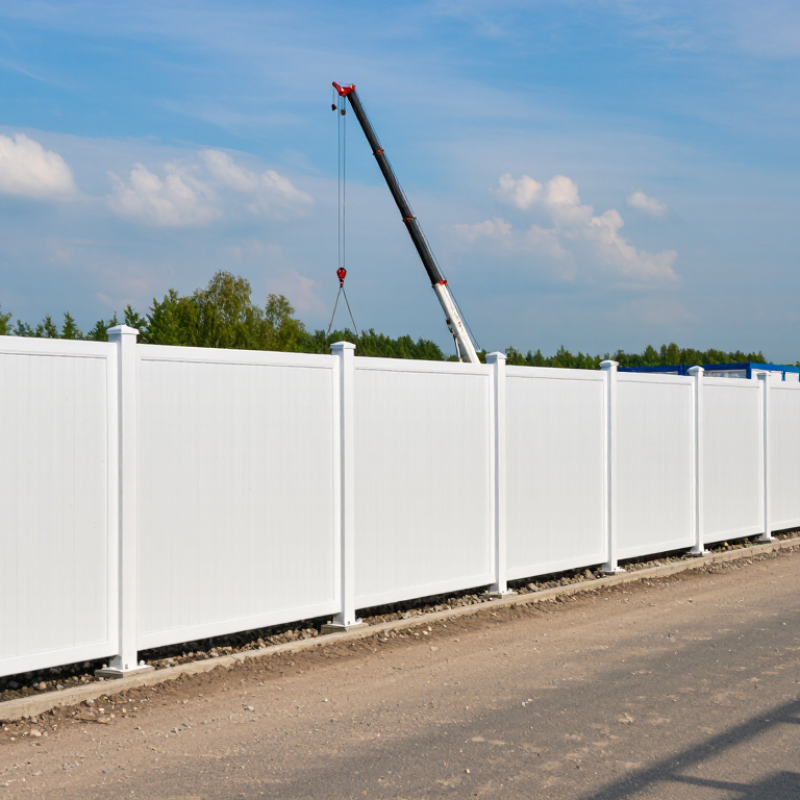
Why Choose Vinyl Panel Fence for Global Projects?

What Is a Vinyl Panel Fence?

A vinyl panel fence is a boundary system made from rigid PVC panels, posts, rails, and connection hardware. The panels usually slide into routed posts or attach to horizontal rails. This creates a continuous surface with fewer visible gaps than many picket fences.

Unlike painted timber, vinyl does not absorb rainwater or require regular staining. Its smooth surface can be cleaned with mild soap and a garden hose. In outdoor projects, installers often check panel thickness, post reinforcement, and UV stabilizers before approving materials. Color matters too. Darker panels may expand more under strong sunlight.

Installation still requires careful planning. Posts need accurate spacing and stable foundations, especially where soil freezes or winds are strong. Concrete depth should follow local engineering guidance, not a rough guess. Panels also need room for thermal movement. Without that allowance, joints may buckle or pull apart.

A vinyl panel fence can suit housing developments, schools, utility sites, and international construction projects. It offers consistent appearance across large boundaries and reduces repainting work. However, it is not maintenance-free. Impact damage, poor anchoring, and low-quality fittings can shorten its service life. I once assumed a neat panel system would hide every installation error. It did not. Small alignment mistakes became obvious in long, straight sections.

How Vinyl Panel Fences Are Designed and Manufactured

Vinyl panel fences begin with the project environment, not a fixed visual style. Designers assess wind loads, soil movement, ultraviolet exposure, and required privacy. Grand View Research’s 2024 vinyl fencing market assessment projects a compound annual growth rate of about 5% through 2030. That demand reflects replacement work, faster installation, and lower routine maintenance.

Manufacturing starts with rigid PVC resin, impact modifiers, stabilizers, and color pigments. The mixture is heated and extruded through a shaped die. Cooling calibrators then control panel thickness and straightness. Hollow rails may receive internal reinforcement for high-wind regions. ASTM F964 provides performance requirements for rigid PVC fence systems, including dimensional and strength considerations. Small errors matter. Uneven cooling can create slight warping.

Quality teams inspect surface finish, dimensions, post alignment, and connection fit. They may use accelerated weathering methods described in ASTM G154 or ISO 4892-3. These tests help compare color retention and material aging, but they cannot perfectly predict every climate. Coastal salt, intense sunlight, and repeated freeze-thaw cycles still require separate engineering judgment. The 2023 Plastics Europe report recorded more than 400 million tonnes of plastics produced worldwide in 2022, showing the scale of the material supply chain. However, recycled content, resin consistency, and transport distances can vary between projects. A practical design should allow field adjustment, because real ground conditions rarely match the drawing exactly.

Why Choose Vinyl Panel Fence for Global Projects?

Representative engineering data shows why vinyl is attractive for lightweight, low-maintenance fence design and manufacturing.

Vinyl refers to rigid PVC. Values are representative material-property figures: density is measured in g/cm³, while linear thermal expansion is measured in 10⁻⁶/K. Actual values vary with formulation, reinforcement, temperature, and manufacturing conditions.

Why Vinyl Panel Fences Suit Global Project Requirements

Why Choose Vinyl Panel Fence for Global Projects?

Vinyl panel fences suit global project requirements because they offer consistent performance across different environments. Their smooth, non-porous surfaces resist moisture, stains, and routine weather exposure. This matters on housing developments, public facilities, and remote construction sites. Panels are also lightweight, which can reduce handling effort during shipping and installation. In my project observations, fewer painting requirements often simplify long-term maintenance planning. However, vinyl is not flawless. Extreme heat, impact, or poor installation can cause distortion or damage. Project teams should review local climate data, wind conditions, and applicable building standards before selecting a system.

Tips: Confirm panel dimensions, fastening methods, and color samples before ordering. Check whether local installers understand expansion gaps and foundation preparation. Keep spare panels available for later repairs, especially on large or distant sites. Small planning errors can become expensive overseas.

Vinyl panel fences also support clearer cost control. Their factory-made components allow more predictable quantities and faster site estimates. They can create a clean boundary around schools, warehouses, residential areas, or utility facilities. The design can appear uniform across multiple countries, while installation details can be adjusted for local ground conditions. Experienced suppliers should provide technical drawings, material specifications, and care instructions. Ask for documented test data rather than relying on attractive claims. A practical review should include transport protection, replacement access, and expected service conditions. Some projects still need stronger materials or specialized barriers. That is worth admitting early.

Why Choose Vinyl Panel Fence for Global Projects? - Why Vinyl Panel Fences Suit Global Project Requirements
Project Dimension Typical Global Project Requirement How Vinyl Panel Fences Respond Practical Project Value
Material Durability Fence systems must remain functional through outdoor exposure, regular handling, and long service periods. Weather-resistant profile
Outdoor-grade PVC vinyl panels do not rust, rot, or corrode like conventional ferrous metal or untreated wood.
Suitable for residential, commercial, agricultural, and public-space applications when the system is correctly specified and installed.
Moisture and Corrosion Control Projects in coastal, humid, or high-rainfall areas require resistance to moisture-related deterioration. Non-metallic construction
PVC is not subject to red-rust corrosion. It also avoids many moisture-related problems associated with untreated timber.
Can reduce corrosion-related maintenance requirements in wet or saline environments, subject to local design conditions.
Ultraviolet Exposure Outdoor products must tolerate sunlight without unacceptable color change, embrittlement, or loss of performance. UV-stabilized formulations
Quality outdoor vinyl fencing commonly uses UV stabilizers and weatherable surface formulations.
Appropriate for sunny regions when the specified product has documented outdoor-weathering performance and installation follows the supplier’s requirements.
Wind and Structural Design Fence performance must account for wind speed, panel size, post spacing, soil conditions, and foundation design. Engineered system approach
Vinyl panels can be combined with reinforced posts, suitable rails, concrete footings, and project-specific spacing.
Adaptable to different wind zones, but wind-load calculations and local building requirements should determine the final configuration.
Thermal Movement Materials installed outdoors must accommodate expansion and contraction caused by temperature changes. Installation-controlled performance
Vinyl expands and contracts more than many rigid materials; slotted connections, clearances, and correct fastening are important.
Reliable across temperature variations when expansion gaps and component tolerances are included in the installation design.
Maintenance Requirements Large projects benefit from low routine labor, simple cleaning, and fewer recurring coating operations. Low routine maintenance
Vinyl generally requires cleaning with water and mild detergent rather than periodic sanding, staining, or repainting.
Helps simplify maintenance planning for distributed sites, housing developments, schools, and facilities.
Installation Efficiency International projects need predictable assembly methods and manageable site labor requirements. Modular panel construction
Posts, rails, and panels can be organized into repeatable installation sequences with standard hand tools and concrete footings.
Supports consistent installation across multiple locations when drawings, component schedules, and site training are standardized.
Transport and Packaging Exported systems should be protected from impact, deformation, moisture, and handling damage during long-distance transport. Lightweight component format
Vinyl panels and hollow profiles are generally lighter than comparable solid masonry or many metal assemblies, but they still require protective packaging.
May improve manual handling and reduce site equipment needs; packaging design should reflect container loading and local delivery conditions.
Aesthetic Consistency Multi-site developments often require a consistent appearance across different climates and installation teams. Repeatable appearance
Factory-produced panels provide consistent profiles, colors, heights, and spacing across project phases.
Useful for residential communities, hospitality sites, parks, and institutional projects with defined visual standards.
Privacy and Safety Projects may need visual screening, controlled access, boundary definition, or separation from active areas. Multiple panel configurations
Privacy, semi-privacy, picket, and decorative layouts can be selected according to visibility, airflow, and access objectives.
Allows one material family to support different perimeter functions while maintaining a coordinated design language.
Chemical and Cleaning Exposure Fences near pools, agricultural areas, roads, or industrial facilities may encounter salts, fertilizers, and routine cleaning agents. Useful chemical resistance
PVC is resistant to many common aqueous substances, although compatibility depends on concentration, temperature, and exposure duration.
Can be suitable for demanding service environments; project specifications should review any unusual chemicals before approval.
Sustainability Considerations Global developments increasingly assess service life, maintenance inputs, material efficiency, and end-of-life options. Long-life and low-coating system
Vinyl fencing does not normally require recurring paint or preservative coatings. PVC can also be mechanically recycled where suitable collection and processing systems exist.
Lifecycle evaluation should include product composition, expected service conditions, transport, repairability, and available regional recycling infrastructure.
Standards and Compliance Projects may require documented testing, engineering data, fire information, accessibility compliance, and local approval. Specification-based selection
The fence should be evaluated against applicable local codes and relevant material or structural standards, such as ASTM or EN requirements where specified.
Improves approval and quality-control processes when test reports, drawings, installation instructions, and traceable product data are available.
Climate Adaptability One project portfolio may include hot, cold, humid, dry, windy, and coastal regions. Configurable system design
Panel profile, reinforcement, post spacing, footing depth, fasteners, and expansion allowances can be adjusted to site conditions.
Provides a flexible platform for international projects, provided regional climate data and soil conditions are included in the design review.
Total Cost of Ownership Owners often compare not only purchase price but also installation, cleaning, repainting, repair, and replacement costs. Lifecycle-oriented option
Lower routine maintenance and resistance to rust and rot can offset part of the initial system cost over the service period.
A whole-life cost comparison should include local labor, transport, foundations, reinforcement, maintenance intervals, and expected replacement cycles.
Specification note: Actual performance depends on resin formulation, UV stabilization, panel and post design, reinforcement, wind exposure, temperature range, soil conditions, installation quality, and compliance with local building requirements. Project-specific engineering review is recommended before final selection.

How Vinyl Panel Fences Perform in Different Climates

Why Choose Vinyl Panel Fence for Global Projects?

Vinyl panel fences behave differently across climates, so design cannot rely on appearance alone. In hot, sunny regions, expansion deserves attention. NOAA’s 1991–2020 Climate Normals record Phoenix summer highs near 106°F, while ultraviolet exposure remains intense. Installers should allow movement at joints and avoid over-tightening fasteners. Rigid PVC profiles meeting ASTM F964 provide a useful specification benchmark, but installation quality still controls field performance.

Humid and coastal locations test drainage, hardware, and surface cleanliness. Miami receives roughly 67 inches of annual rain, according to NOAA climate normals. Vinyl resists rot and insect damage, yet trapped water can stain panels or weaken adjacent posts. In freeze-prone areas, frost movement and brittle winter handling require deeper, well-drained foundations. Snow and wind loads also need project-specific checks under ASCE/SEI 7-22.

It is not maintenance-free. I would not specify identical spacing for Arizona and northern Europe. That shortcut can create warped lines, loose gates, or premature repairs. A site review should compare local temperature ranges, wind exposure, soil movement, and cleaning access before procurement. Small installation gaps matter.

What to Consider Before Choosing Vinyl Panel Fencing Worldwide

Why Choose Vinyl Panel Fence for Global Projects?

Before choosing vinyl panel fencing worldwide, project teams must examine climate, codes, shipping, and long-term performance. A low-maintenance promise is not maintenance-free. Vinyl can resist rot and insects, but extreme heat may increase thermal movement. Cold conditions can make panels less flexible. Wind exposure also requires engineered posts, spacing, and concrete depth.

Grand View Research estimated the global fencing market at approximately USD 30.2 billion in 2022, with projected growth of about 5.8% annually through 2030. This growth does not guarantee suitability for every region. The specification should include ultraviolet resistance, impact performance, drainage, color stability, and replacement-part availability. Local wind-load rules and installation practices deserve equal attention. I would not approve a global specification from a catalog alone.

Tips: Request climate-specific test data, not general marketing claims. Confirm shipment dimensions before finalizing container plans. Check whether installers understand expansion gaps and post alignment. Review recycled-content claims against recognized environmental documentation. The International Organization for Standardization’s ISO 14040 framework can guide life-cycle assessment, although project data may remain incomplete. That is a weakness worth admitting. A fence may look identical across markets, yet soil, sunlight, labor, and maintenance habits can differ sharply.

FAQS

What is a vinyl panel fence?

It is a boundary system made from rigid PVC panels, posts, rails, and connection hardware. The panels create a continuous surface.

Where can vinyl panel fences be used?

They can surround homes, schools, warehouses, utility sites, and large construction projects. Their appearance stays consistent across long boundaries.

Why do project teams choose vinyl panels?

Vinyl resists moisture and stains without regular painting or staining. Its lightweight parts can simplify handling, transport, and installation.

Is a vinyl panel fence maintenance-free?

No. Mild soap and a garden hose usually remove surface dirt. Damaged panels, loose fittings, and leaning posts still need attention.

What should be checked before ordering?

Confirm panel dimensions, thickness, post reinforcement, UV stabilizers, fittings, and color samples. Also request technical drawings and documented test data.

How does climate affect installation?

Strong sunlight can expand darker panels. Frozen soil, high winds, and extreme heat may require deeper foundations or stronger materials.

Why are expansion gaps important?

Panels need space for thermal movement. Without it, joints may buckle or separate. Measure twice.

What common installation mistake should teams avoid?

Do not guess post spacing or concrete depth. Small alignment errors become obvious along long, straight sections. I once underestimated that.

How can overseas projects control costs?

Factory-made components support clearer quantity estimates. Keep spare panels available, especially when replacement access is difficult.

Is vinyl suitable for every boundary project?

Not always. High-impact areas or demanding conditions may need stronger materials or specialized barriers. That limitation deserves early discussion.

Conclusion

A vinyl panel fence is a modular fencing system made from durable, weather-resistant vinyl components, typically including posts, rails, and solid or decorative panels. Its design supports efficient manufacturing through standardized profiles, reinforced connections, and carefully controlled assembly, helping create consistent quality and simplified installation for residential, commercial, and infrastructure projects. Compared with many traditional materials, vinyl requires minimal maintenance because it does not rust, rot, or need regular painting.

For global projects, a vinyl panel fence can offer practical advantages in diverse climates, including humid, coastal, sunny, cold, and rainy environments. Its performance depends on material quality, structural design, UV resistance, temperature flexibility, drainage, and proper installation methods. Before selecting vinyl fencing worldwide, project planners should consider local weather conditions, wind loads, ground stability, panel dimensions, color expectations, transportation, installation expertise, and long-term maintenance needs. Careful evaluation ensures the fencing solution matches both project requirements and site conditions.

Charlotte

Charlotte

Charlotte is a seasoned marketing professional with a deep understanding of the company's portfolio and a passion for elevating its presence in the market. With a keen eye for detail and a commitment to excellence, she ensures that our professional blog is regularly updated with insightful articles......